Experimental cooking can be a source of deep joy--or agony--depending on how it turns out. The perfect meal shared with a good companion puts me in a deliciously good mood. But unhealthy, un-tasty, untimely meals put me in a frump. This is my quest for good foods and good moods.
Thursday, May 05, 2011
Goat Cheese Pizza
To make, I followed the foccacia bread recipe from my 3 and 4 ingredient cookbook (it makes a softer dough than the usual pizza crust, which I need because my TMJ has been acting up lately and I can't chew chewy or crunchy things enjoyably).
To make it, I proofed one T of dry yeast in scant 2 cups warm water with a T of sugar. Then I added a splash of olive oil, 4 cups flour (a mix of bread and unbleached all purpose because I was at the end of my bag of King Arthur's) and a pinch of salt. I let it rise 'til double, punched down, divided it into two balls and rolled them out to roughly match the shape of my jelly roll pans.
One pizza got a topping of sliced tomato, mozzerella, fresh spinach, minced garlic, olive oil, dried parsley and basil and the goat cheese, of course.
The second pizza had pepperoni, tomato, oil, sweet onion, zuchinni, spinach and the herbs along with the goat cheese, except for one corner that I did up with tomatoes, spaghetti sauce and muenster cheese for Stephen.
I recommend drizzling oil on top of all the other ingredients, especially the spinach, which will get all crispy and translucent if you cook it long enough. I like crispy spinach.
And, I made some lemon bars for dessert.
Saturday, November 14, 2009
Da Vinci Little Italian Restaurant

Italian chef opens North Drive eatery
By Emily Parrino, Special to the New Era
Published: Wednesday, October 21, 2009 12:53 PM CDT
Pavel Skorpil’s signature Italian salad dressing, marinara sauce and pizza dough are all freshly made. Alexa Becker rattled off the list as though she was preparing for a quiz.
“Pavel, you make your meatballs from scratch?” she directed the question toward the kitchen where her husband was rolling out pizza dough.
“Yes I do,” Pavel fired back.
“He makes them from scratch,” Alexa repeated.
“You didn’t know this?” Pavel shouted from the kitchen, feigning indignation. “You’re fired!”
“Yeah, he makes everything from scratch,” Alexa said. “I am so glad I don’t work in the kitchen.”
The feisty couple are chef and head server of Da Vinci Little Italian Restaurant, an eatery in the former Pizza Roma storefront on North Drive. Pavel is keen on treating the town to authentic Italian, but is also learning what locals like.
Since opening on Oct. 13, they’ve been selling mounds of meaty entrées.
“The first day, everyone wanted meat lover’s pizza,” Alexa explained. “The second day it was all Italian Sausage sandwiches. It was like everyone was calling their friends and telling them to order the same thing.”
Spaghetti and meatballs and lasagna with meat sauce have also been big sellers. Pavel also offers an Italian-style pulled pork sandwich with mushrooms and creamy gravy on foccia. In a town where meat-and-three is a menu staple, Alexa urged her husband to offer traditional barbecue sauce as a substitute to the Italian gravy.
“A lady ordered it the other day,” Alexa said, “and she was surprised.”
“She thought the flavors went well together,” Pavel said.
Pavel, originally from Italy, and Alexa, a German native, met and fell in love at a restaurant in Clarksville, Tenn., where they both worked. Pavel had initially come to the U.S. to be chef of a restaurant in Destin, Fla., before moving to Atlanta and eventually Clarksville. Each time, Pavel cooked a menu according to the owner’s set recipes and specifications.
After the Clarksville venue closed, Alexa urged her husband to be a chef once more, but this time using his own recipes.
“I told Pavel, ‘You should quit working for other people and open your own restaurant,’” Alexa said.
The couple agreed on opening Da Vinci in Hopkinsville, lured by the lower cost of rent and hoping to bring authentic Italy to the locals.
The bustle of business their opening week seemed to heat husband and wife up with the intensity of the Blodgett stone pizza oven that fills Pavel’s kitchen.
“We yell so much,” Alexa said. “But we don’t take it home with us.”
These days they don’t go home very often. The restaurant is open Tuesday through Sunday for lunch and dinner, with Pavel staying up, sometimes until 2 a.m. to make his dough from scratch.
“I am always busy,” he said. “I was born busy!”
“He makes dough by hand, using fresh ingredients,” Alexa explained. “One time he put a towel over the bowl and said, ‘Shh! Everybody be quiet because if you’re loud it will sink.’”
Pavel trained at a cooking school in Bolzano, northern Italy, but he learned his favorite dish, lasagna, from cooking under his grandmother in Milan. He still calls his popular recipe “Nona Lasagne,” using the Italian word for grandma.
In addition to the long hours, bringing Italian food culture to Hopkinsville has proved challenging. In Italy, lunch breaks are typically two hours, Pavel said.
“So if you go in a restaurant, the cook will make the pasta and bring it to you fresh, which takes between 10 and 15 minutes to prepare,” Pavel said. “You can’t do this because people here have only 30 or 40 minutes for lunch.”
He also decided to offer some decidedly American items like buffalo wings, deep pan pizza and cheese sticks alongside authentic Italian items like Mussels Alla Diavola and Calamari Fritti.
Still, Pavel is proud to make the majority of his menu from fresh ingredients. He tells Alexa to tell customers he uses specially ordered unbleached flour to make his dough.
“Unbleached flour is much better for your stomach,” Pavel said.
Pavel’s original recipes include Da Vinci Salad with mixed greens, grilled chicken, sauteed mushrooms, tomatoes and feta; and his White Pizza, topped with crème, mozzarella, roma tomatoes, proscuitto and mushrooms.
The restaurateurs say their menu and long hours have won them many compliments.
Several of Da Vinci’s diners early Saturday evening were repeat customers.
“It was delicious again,” a woman said to the server as she left.
“Bye y’all,” Alexa said with a convincing twang. “Have a great day!”
Monday, July 28, 2008
Sicillian Pizza

Celebrity chef, world traveler visits Hoptown
John Ashton to host Relish Cooking School and Expo in September
By Emily Parrino, New Era Features Editor
Wednesday, July 30, 2008 12:42 PM CDT
Jon Ashton picked up a bunch of chubby carrots from farmer Patrick Holland’s table at the Founders Square Farmers Market.
“They’ve got character,” he said as some other vegetables caught his eyes, “The tomatoes look so happy, don’t they?”
A celebrity chef originally from Liverpool, England, Ashton has made numerous TV appearances and traveled, cooked and tasted foods from all over Europe and Asia. But he felt right at home in a small-town American farmers market.
“This is more quaint than pushing a shopping cart through a place where every 15 minutes there’s a thunderstorm and the mist comes down on the produce,” he said.
Ashton will be the host at the Relish Cooking School & Expo to be held at 7 p.m. Sept. 11 at the James E. Bruce Convention Center. The event will feature a variety of food and home related exhibits and hands-on activities. Those who attend will also have the chance to win a $10,000 kitchen makeover from Cayce Mill Supply.
Ashton visited The Kentucky New Era and Hopkinsville recently to scope out the surroundings and prepare for the expo.
“It’s great to bring children to a place like this and have the farmers tell their stories,” Ashton said as he perused the market, “This gentleman retired and began farming, this other gentleman left teaching to become a farmer. Most people don’t follow their passion in life.”
Locally grown food and nutritious eating are among Ashton’s passions. He has a kitchen garden of his own at his Florida home and loves cooking up meals for his neighbors with his homegrown produce.
“It’s addictive, isn’t it, when you start gardening?” Ashton said to Holland. “Now I name all my vegetables. There’s Willie the Watermelon, Elvis Parsley.”
Ashton also agrees with Holland that plants will thrive with some tender words of encouragement. But getting to know his veggies on a first-name basis doesn’t stop Ashton from eating them or sharing the bounty with friends.
“My neighbors are all welcome to my garden,” he said. “My daughter, Mei, will pick herbs and knock at the doors and give them to the neighbors. My goal is to encourage them to eat fresh produce.”
The chef requires no encouragement, he was craving a salad with mint, lemon juice and tomatoes for lunch. He also recommends oven-drying garden tomatoes to intensify their flavor.
“I heat them at 275 degrees with some oil and herbs,” Ashton explained. “It makes a lovely gift for the neighbors. You can use it to make tomato sauce or a tapenade, to spread on sandwiches.”
Full of vitamin C and the anti-oxidant lycopene, the nutrition conscious cook couldn’t praise the tomato enough. Another way to enjoy the tart vegetables is on a thin-crust pizza reminiscent of the snack served in Sicily.
Jon’s Sicilian Pizza Crust
“This is a wet dough, after it has proofed it will be easier to handle,” Ashton says. He believes cooking the crust on a clay stone in an oven that’s been preheating at 500 degrees at least 30 minutes will produce the most authentic results.
3 3/4 cups bread flour, plus additional for rolling out.
1 packet dried yeast
pinch salt
1 1/2 cups lukewarm water
2 tablespoon white wine
Fresh Garden topping:
4 ripe tomatoes
1 head garlic
1 small yellow onion
1 cup fresh basil, divided
a few shakes dried oregano
olive oil
Coarsely chop basil, onion, garlic and tomato. Sauté garlic and onions in oil. Once fragrant, add tomatoes and ¼ cup basil and oregano to taste. Cook down until most of the juices have evaporated.
Mix dry ingredients with fingers and make a well in the center. Add wet ingredients and knead. It makes a really sticky dough. Knead for 7 to 10 minutes. Divide dough into four balls. With each ball, push out the dough with the heel of your hand to stretch it. You’ll see the strands of yeast. Then roll out to the thickness of a tortilla. The shape doesn’t need to be perfectly round. Let the dough rounds rest 30 minutes.
Use a dusting of cornmeal on the bottom of each crust to keep them from sticking. Brush the top with oil. Add garlic, salt and pepper, homemade tomato sauce. Cook pizza on the clay stone for 6 minutes. Then bring it back out and add basil, real buffalo mozzarella and reggiano-parmesan. Return to the oven until cheese is melted and basil crispy.
QuickInfo: Jon Ashton
Who: Celebrity chef with a passion for children, healthy eating and locally grown produce
What: Ashton will host the Relish Cooking School & Expo
When: 7 p.m. Sept. 11, 2008
Where: James E. Bruce Convention Center
Online: www.jonashton.com
Tickets: $10 general admission or $25 V.I.P. admission which includes cookbook, up-front seating, and pre-show “Meet, Mingle, and Munch” with Jon. A $2 discount applies for New Era subscribers if tickets are purchased at the New Era. Tickets are available at the New Era, Cayce Mill Design Center, the James E. Bruce Convention Center and the Fort Campbell Courier office.
Have a winning recipe?
Some lucky New Era reader could share the stage with celebrity chef Jon Ashton on Sept. 11 during his appearance at the Relish Cooking School and Expo, sponsored by the KNE.
Send us your favorite recipe and, if it’s chosen the winner, Ashton will call the local cook on stage for assistance during his show and the recipe will be distributed to everyone attending the show to be held at the James E. Bruce Convention Center.
Choose whatever category you’d like – appetizer, drink, salad, soup, entrée or dessert.
Many of the recipes will be featured in a special KNE cooking section on Sept. 4.
Send the recipe to KNE reporter Julia Hunter at Box 729, Hopkinsville, KY 42241. Recipes must be received by Aug. 20 and must include the submitter’s name, address and daytime telephone number.
Emily Parrino can be reached at 270-887-3235 or eparrino@kentuckynewera.com.
Sunday, June 29, 2008
Glass art
Artist Stephen Rolfe Powell's wonderful world of glasswork
By Emily Parrino, New Era Features Editor
Saturday, July 5, 2008 12:48 AM CDT
Studded in bands of bead-like murrini, indigo neck stretching upward like warm taffy, the giant glass vessel in the entrance of Cadiz’s Janice Mason Art Museum has the cool elegance of an ice sculpture.
But there’s something wild brewing inside. The title of the piece, “Tropical Sarcastic Cleavage,” might be the first hint of the glass jungle awaiting visitors just around the corner.
Before entering the gallery, visitors are invited to take a seat on the lobby sofas, where a seven-minute video shows Powell and crew at work in their studio.
Some are clad in elbow-high oven mitts, some in space suits. Some wield torches and others heft poles that puncture the stretchy molten gobs of glass, which they manipulate to the beat of a Led Zeppelin soundtrack.
“It looks crazy,” Powell said, “It is.”
There’s not a lot of communication while the music blares. Instead each assistant knows their role, pulsing around the nascent creation. It’s heated to 2,100 degrees, and they must massage it with blow torches to maintain its viability. If the glass drops below 1,000 degrees, Powell explains, the piece will stiffen and shatter. Plenty of the pieces never make it out of the studio.
But for the last move, they turn off the music so they can concentrate. In a span of a minute or two, the 30-pound sculpture gets its finishing touches. Hands muffed in insulated cylinders, Powell coaxes out the flamingo-like neck of the “Screamer” —– his third and most refined series of blown glass pieces, named for their avian qualities.
“We felt like with their posture, they’re more birdlike,” Powell explained. “There’s a potential for them to make a trumpeting or screaming sound.”
But silently now, the crew in the video transfers the nearly finished piece to an 800-degree oven to cool. Later, the base and neck will be cut and smoothed so the vitreous creature can stand on its own, in a permanent gallery or traveling show such as this month’s exhibit at the Janice Mason Art Museum in Cadiz.
Powell, an internationally known artist, teaches glass and ceramics at Centre College in Danville, Ky. His pieces, with personalities and titles like “Pushy Violet Throb” or “Poochy Serpentine Striker,” can sell for tens of thousands of dollars and are on display in metropolitan galleries across the nation.
The curators at JMAM were able to woo him to Cadiz in honor of the museum’s 10-year anniversary. Powell arrived at the museum last weekend to set up the display and give a lecture and book signing at a reception last Friday evening.
His exhibit features “Teasers,” a class of vessels with symmetrical, often lobed bases, with human qualities are from his earliest years of artistry. There are also “Wackos,” asymmetrical and animal-like beings that stand on two curly-cue legs. The graceful-necked “Screamers” are the culmination of Powell’s evolutionary kingdom.
Typically christened with three-word titles, Powell’s pieces seem to follow a nomenclature like Carl Linneaus’ plants. But the artist insists there’s no scientific taxonomy behind “Tangy Winking Orb” or “Frenetic Nubile Nod.” It’s more like a magic kingdom where characters’ names evoke humor and whimsy.
Powell’s work is the product of the American school of glass art. As opposed to the traditional Venetian school, which emphasizes following a standard set of techniques, American glasswork is idea-oriented.
“I don’t think you can achieve the looseness of shape with the traditional, Venetian school of glass blowing,” Powell said.
Which is not to say Powell and his assistants shirk all things traditional. Layers of thousands of bead-like murrini that lend his pieces the look of eons of geological strata are the most time-consuming feature of every piece.
“A lot of work is done outside the hotshop,” he said. “There’s probably 12 to 20 hours in a piece for making murrini.”
To create the tiny beads, the glassmakers heat softball sized blobs of colored glass, wrapping one color around another then stretching the hot hailstone into a long rod, which is allowed to cool.
“Then we spend hours chopping them into pieces of uniform width,” Powell explained. The resulting beads, some the size of gems, others the size of cookies cut from a rolled out “dough” are arranged on a flat surface in intricate patterns and eventually sheath the molten glass. As the glass is blown, contorted and stretched, the murrini are transformed as the sculptured “buns,” “pooches,” “orbs” and “puffers” come to life.
Despite the use of traditional murrini to texture and color his pieces, Powell maintains his uniqueness in a relatively new field, trailblazed by American glass artists like Dale Chihully.
“Nobody else in the world works like this,” Powell said of his methods.
And it’s a good thing; “It’s easier to copy someone who works in the traditional way.”
As a teacher, he shows his students examples of copycat artists, then he urges them not to become one.
“Teaching technique is the easy part,” he said. “The challenge for me as a teacher is to develop students as artists with their own style and way of working.”
Many of his students go on to do just that. Che Rhodes left Powell’s tutelage to become the head of the glass department at the University of Louisville, the only other glass program in the state.
In Powell’s hotshop, the evolution from Teaser to Wacko to Screamer seems to have paused for now. But those who enjoy the vitreous safari at JMAM might be interested in what the future holds. Powell’s next big project involves a hanging menagerie of glass pieces. For his first installation, the artist envisions 350 10-inch pieces suspended from the rotunda of the Danville library.
“It will funnel out, made of individual pieces that will be a solid color, stacked close to each other like murrini,” he said. “It will be like being inside one of my pieces.”
QuickInfo: Stephen Powell Retrospective
Blown glass pieces by internationally renowned artist Stephen Rolfe Powell will be on display through Sept. 14 at the Janice Mason Art Museum on Main Street in Cadiz. Powell is a professor at Centre College in Danville, Ky. The exhibit celebrates of the museum’s 10th anniversary.
Emily Parrino can be reached at 270-887-3235 or eparrino@kentuckynewera.com.
Monday, May 26, 2008
Borders Farm berry picking
I wanted to do a column on strawberry picking...and so while dad and Joe were off fishing with Ricky, Mom and I went out to Elkton to get U-pick strawberries for 75 cents a quart.
We decided it's a lot of work picking strawberries in the hot sun if you're a)29 weeks pregnant or b)in your fifties. But we came home with lots and lots and lots of strawberries.
Little River Days
Food Fest
2008 Little Rivers Day eats: Tasty treats or overfried duds?
Wednesday, May 21, 2008 1:49 PM CDT
The variety of vendors at this year’s Little River Days Festival turned Founders Square into a deep-fried wonderland last weekend. Festival food is usually over-the-top in calories and price. There’s often interesting combinations that festival goers would never dream of creating in their own kitchens.
This weekend I gathered some willing accomplices and set out to find the best of the fair fare. Together, we managed to sample eight items and make it out of the festival without going into cardiac arrest.
My picks? Sweetater fries, fried green tomatoes and funnel cakes are the treats I’ll be looking forward to at next year’s Little River Days.
Potato Ribbons
$5 at R&L Catering
R&L Catering had at least two booths at the fair this year and typically drew long lines of snackers.
While the use of the term “ribbons” makes this dish sound exotic and yummy, I found this it to be a little disappointing. For $5, you get a paper plate loaded with fairly bland, slightly overcooked, spiral-cut potato chips. Warm chips are a novelty and the volume of “ribbons” is generous, but flavor is lacking. I let my husband finish this dish after trying a handful. Perhaps barbecue flavor or salt and vinegar could have saved them.
If you crave homemade potato chips now that Little River Days has ended, Livingston’s Butcher Shop and Deli on North Drive usually serves thick, hearty chips still warm from the fryer.
Sweetater Fries
$3 at What About Bob?
This distinctive booth features a grass table skirt and parasol. Bob Denton himself reached through the tiny window of his vintage trailer to pass a cardboard tray of well-done sweet potato fries to his cashier, Judy Simon. Simon said that the fries, along with the fish sandwiches, were their best sellers.
I shared my fries with a friend, Emily, and her twin 4-year-olds Philip and Esther. Like the potato ribbons, sweetater fries come without much adornment, so I squeezed ketchup in one corner of the tray. My friend had hoped they would be sprinkled in cinnamon and sugar, but I thought they tasted great slathered in ketchup. Esther tried one fry and said, “I thought they were bacons.” Philip seemed to enjoy them more and said he liked his with ketchup as well.
Fried Green Tomatoes
$4 at R&L Catering
The cashier at R&L said that this item, which featured six large slices in a crispy batter, along with the blooming onion, were their most popular sellers. This was one of my favorite snacks — the balance of batter and tangy tomato was just right, and they were nicely seasoned with salt and black pepper. Emily and I also comforted ourselves with the thought that we were eating deep fried vegetables, which added a little bit of nutrition to our meal.
Not everyone in my taste-testing crew agreed. Esther took one bite, put it back in the tray and shouted, “I wanna ride the train!” Philip managed to eat more of his slice, but eventually declared “Mommy, I don’t like the pepper.”
Rib Sandwich
$5 at Pioneer’s, Inc.
Three plump pork ribs draped over two slices of white bread is not my idea of a conventional sandwich. But the Pioneer’s knew what they’re doing. The bread simply serves as a way to blot up the extra grease and sauce from the meat, though Emily did tear off a few pieces.
I found the ribs to be rich and flavorful, though the edge piece I had was overcooked to the texture of jerky. The meat nearest the bone, on the other hand, was very tender. We both liked the thin, tangy sauce that was available in a squirt bottle at the stand. While most concession stands come from out of town, Pioneer’s is a local institution.
Funnel Cake
$4 at R&L Catering
Funnel cakes, with their pull-apart structure and heavy pile of powdered sugar, are the quintessential carnival food. I can never pass them up, even though I have been disappointed. Sometimes the confection isn’t fully cooked and reveals an oozing and unsanitary batter center, other times it’s overcooked (or refried?) and becomes tough and chewy as soon as it has cool. There’s no mountain of sugar that can cover up those mistakes.
The funnel cake at R&L was perfectly cooked. While Emily and I were working on the ribs, Philip had pulled apart and consumed half the cake. When we were ready for our portion of the dessert, he declared, “I had too much of a good thing!” and then asked mom if he might have one more bite.
Chocolate-dipped strawberries
$3 at Marty Lane
When I first heard about these from Recreation Department Director Pam Rudd, I was eager to try them. Chocolate dipped fruit sounded almost too gourmet to be at a spring fair. My imaginations might have set too high a standard.
Marty Lane’s strawberries are frozen and skewered three to a stick. The strawberries were deep red and the size of a child’s fist. I like the idea of being able to eat whole fruits, but frozen solid, these were tricky and teeth-tingling to consume. Also, I felt the chocolate coating had very little chocolate flavor. They seemed to have been stored in a freezer case where they absorbed a dozen flavors from the other snacks stored there. Next year I’ll just dip my own strawberries.
Chocolate-dipped banana
$3 at Marty Lane
A whole banana, kebabbed and coated in the same low-quality chocolate shell as the strawberries, this dessert was softer and a little easier on the teeth. But it was merely a substitute for the stand’s popular chocolate-coated cheesecake, which had sold out by the time my husband got there.
Again, Joe and I liked that we could find something semi-healthful amid the deep fried Oreos and candy bars. He seemed to enjoy the dessert, but I found the lingering mystery flavors in the coating distracting.
Deep fried Ding Dong
$4 at Marty Lane
You didn’t think I was going to pass this one up, did you? This dessert didn’t know where to quit. The chocolate-coated snack cake with crème filling gets an additional chewy donut batter coating. It’s served on a stick and sits in a pool of chocolate sauce, beneath a mound of powdered sugar. My teeth hurt just thinking about it.
Joe and I thought it was pretty good, at first bite. But we both agreed it would have been better if we had a third person to share it with.
Emily Parrino can be reached at 887-3235 or eparrino@kentuckynewera.com.
Thursday, May 15, 2008
Pattypan squash in three ways
Wednesday, October 10, 2007
Hummus
Chickpea dip a simple way to whip up Middle East flavors
Wednesday, October 10, 2007 12:21 PM CDT
TASTE BUD TRAVELS | EMILY PARRINO
Ramadan, the Muslim holy month of fasting and faithful reflection, is coming to an end this week. At a time when many Americans are preparing for the biggest holiday meal of the year, and looking forward to filling Christmas cookie tins, Muslims in America and all over the world are abstaining from food and drink from dawn til dusk.
I admire both their sacrifice and their homey, food-filled celebrations after the sun sets.
When I was a graduate student in Champaign, Ill., a friend invited me to her home to break the fast with other Muslim women. I was curious to see how a segment of Americans — often seen as a mystery — live during Ramadan. And more importantly, I was eager to eat a Middle Eastern feast.
My hostess said she actually gains weight during the month of fasting because of the decadent nightly potlucks. The women in the house had been cooking for some time —preparing not one, but two identical meals because the men in their religious community meet in a separate house.
After kneeling with noses to the carpet in prayer, the women crowded into the dining room to fill their plates. I followed the line to the table, hoping for chickpea appetizers like hummus and falafel. I hoped there would be a parsely-rich fatoosh salad or savory marinated kebabs.
I was a little shocked to discover a roasted turkey, stuffing and mashed sweet potatoes spread upon the buffet table. The theme for that night’s meal, my hostess informed me, was an American Thanksgiving meal.
Fortunately, many Middle Eastern dishes are simple to prepare at home. To get my fix of the zesty flavors of the region, I like to make my own hummus — a dip traditionally made from chickpeas and sesame paste, seasoned with lemon juice and garlic.
The addictive flavors complement fresh vegetables and can be used in pita sandwiches. In addition to being tasty and versatile, hummus’ fiber-packed bean base is very healthful.
Easy At-home Hummus
1 15-ounce can chickpeas
1 large lemon
2 tablespoons olive oil
3 large cloves chopped garlic, or to taste
1 tablespoon toasted sesame seeds
Drain chickpeas, reserving liquid. Add chickpeas, sesame seeds, garlic and oil to a blender or food processor and squeeze lemon juice over it all. Blend ingredients until smooth, adding a little of the reserved liquid at a time to make the mixture blend more smoothly.
Pour hummus onto a serving plate and drizzle with a little olive oil. Sprinkle with sesame seeds and ground cumin, if desired.
Enjoy hummus as a dip for toasted pita wedges, carrot sticks and cucumber slices or spread it on a crunchy falafel sandwich in place of mayo.
Pan-fried Falafel Patties
1 15-ounce can chickpeas
3 tablespoons finely chopped onion
2 teaspoons cumin
1/4 teaspoon salt (or to taste)
oil for frying
Drain chickpeas then mash them with a fork until the mixture binds together but is still chunky. Add cumin, salt and onion and continue mashing until blended. Shape mixture into 2-inch patties. Coat a non-stick frying pan in canola or olive oil and turn on medium heat. Fry falafel patties until golden brown on each side. Serve in a pita with hummus, lettuce, tomato and cucumber or serve as a finger food with plain yogurt as a dip.
Emily Parrino is a New Era copy editor. She can be reached at 887-3298 or eparrino@kentuckynewera.com.
Wednesday, September 19, 2007
African finger foods
African Finger foods
In Tanzania, corn dough balls make for sticky hands, full tummies
Wednesday, September 19, 2007 1:56 PM CDT
Taste bud travels | By Emily Parrino
Emily Chappelear had never eaten African food before moving to Tanzania at age 20. She’d never bargained for meats and vegetables at an open-air market. And as a missionary student accustomed to eating dormitory food, Emily had never learned to cook.
“We ate spaghetti noodles with butter and salt the first week,” she told me recently as she moved through her kitchen, alternately flipping fat chapatis in a skillet and chopping vegetables for a traditional East African stew.
Emily and her husband, Ryan, moved to Hopkinsville in July, bringing with them Africa For Jesus, a non-profit organization they founded 5 years ago before that first trip to Tanzania.
The Chappelears were kind enough to treat us to a home cooked meal, and my husband, Joe, and I were eager to try a new ethnic cuisine.
On the menu for the evening: Ugali, a dense porridge ball made from finely ground corn, used for scooping up a curried stew of carrots, beef, tomato, peppers and onions. A warm salad of shredded cabbage, green peppers, carrot and spices rounded off the meal along with chapati, pan-fried flatbread rounds, used as additional scoopers.
Emily learned to cook the Tanzanian meal by scrutinizing her house-helper, Monika, in the kitchen. It wasn’t easy, because Monika, and Tanzanians in general, didn’t use recipes.
Another thing typically absent from the African table is forks and spoons. Africans eat with their fingertips. Traditionally, all eat from the same serving dishes — plucking off a small piece of ugali and rolling it into a ball, then making a divot in the center to scoop up mouthfuls of runnier dishes.
Digging in might seem unsanitary or uncultured to the Western opinion, but in Africa there’s an art to eating.
“They’re really tidy,” Emily explained, flicking drops of stew onto her plate.
My fingernails were already full of ugali, and stew was making its way up my husband’s wrists. Our host said we were doing OK for our first hand-held meal.
“They laughed at us because at first we had stew dripping down to our elbows,” she said.
Despite the mess factor, scooping up food with food has its advantages. There’s nothing metallic standing between the savory flavors and the tongue.
The starchy ugali sits like a rock. By the time our dinner party was winding down, there was still a sizeable mass left untouched. The dish is filling by design, the Chappelears explain.
“After walking for miles and miles each day, you begin to crave the feeling of ugali in your stomach — the feeling of fullness,” Emily said.
Though the corn mush was once a staple for the Chappelear family, they only eat African food every couple of months now.
“We eat it sparingly, since we have to import it from Africa ourselves,” Emily said.
The Chappelears’ twin 4-year-olds, Esther and Phillip, are always excited when they can eat a meal of African finger foods. Their mom pre-rolled a dozen marble-sized ugali balls for them to dip.
But when ugali isn’t available, the Chappelear kids improvise.
“Because of learning to dip ugali, Esther likes to do that with all of her American food,” Emily said. “She’ll just dip whatever she’s eating into her drink.”
Saturday, July 21, 2007
Amish Aisles
Country Pantry a foodie's oasis in rural Kentucky
My parents, visitors from Chicago, seem to know the food landscape of western Kentucky better than I do. They know the owner of their favorite barbecue place on a first-name and nickname basis. They know that their favorite bakery isn’t open Thursdays or Sundays. And they know just the place to get 10-grain cereal for $1.19 per pound.
During their last visit, they introduced me to the Amish-owned bulk food store called the Country Pantry.
I was expecting a rather drab store — maybe a modified room attached to someone’s home — with perhaps a dozen different healthful items akin to the 10-grain cereal. I did not expect a building packed with thousands of diverse goods rivaling the selection of a metropolitan market.
As I scanned the shelves, I found long-lost friends like Asian vegetable chips, dried shitakes, whole flaxseed and wasabi peas. There were also intriguing curiosities like Turkish apricots, Lebanese bologna, purple sticky rice, gummy penguins, cow-shaped sprinkles and fair-trade vanilla.On Saturday I talked with Mary Miller, 26, in the third aisle of the store. Miller is the granddaughter of the Guthrie Road building’s owner and niece to two aunts who own the inventory.
I told her how enamored I was with the selection, especially the ethnic finds. My personal favorite — crunchy dried carrot, sweet potato, squash, taro and green bean chips — let me relive some tasty snacking from my time living in Taiwan. Since moving back to the states, I’ve only found them at one specialty store outside Chicago. But there, standing in a corrugated metal building in rural Kentucky, I found my exotic treat for half the price.
Miller said the Country Pantry has sold the veggie chips at least since 2002, when she started working there. And she told me I’m not the only one who is excited to find them.“The customers buy a lot of them, they say they can’t find them other places,” Miller said.
Customers request new items every week. Recently, many customers have been crazy over quinoa, a round yellowish grain high in protein. Miller said people also asked for organic cheese, but they haven’t been buying much.I was a little surprised how few of the store’s items are Amish-made, and that even fewer are produced by local Amish.While they do sell country fare like shoofly pie mix, fresh churned butter, and pickled everything, Miller said they want to avoid turning their Amish lifestyle into a commercial brand.“We try to stay away from the Amish-made label,” Miller said, “Because I don’t want people to buy it because it’s Amish. I want them to buy it because they want it.”
So far that principle seems to be working. The store’s selection draws people from Christian County, Clarksville, Nashville and if you count my mom and dad, Chicago.
My husband, Joe, and I found several things we wanted, and narrowed our purchases down to a bag of veggie chips, a cast iron skillet and a cookbook by a globe-trotting Mennonite couple who served as missionaries in Bangladesh. I’m looking forward to trying the recipes for Thai Chicken Salad, Tandoori Cauliflower and Quick Praline Sticky Buns.
QuickInfo: Country Pantry Located at 9115 Guthrie Road. To get there, take Pembroke Road south to 848 East. Turn south on 181. The store is on the right. The store is open Monday through Saturday from 8:30 a.m. to 5 pm. Phone: (270) 483-0555
Emily Parrino is a New Era copy editor. She can be reached at 887-3298 or eparrino@kentuckynewera.com.
Thursday, June 21, 2007
English lesson, cooking class

I made my own Udon Monday night. I think they came out pretty good. I like the way they become a little softer the second day.
Recently I've decided to spend every Tuesday afternoon with my nieghbor, Saya. This past Tuesday we made garden zucchini muffins (what, you didn't think they'd last long enough to get their picture taken, did you?) and talked about the different kinds of accents in Shrek 3 and in various Japanese cities. Next week, I'm hoping she'll bring another Japanese friend. I miss my English-teaching days at ortv.
Update: Here's the column I wrote about making noodles from scratch.
Cold comfort
Chilled noodle soup can quench the summer heat
Taste bud travels By Emily Parrino
I love hot noodle soup on a winter day. And even in summer, I don’t mind slurping steaming broth in an air-conditioned kitchen.The air conditioning at our neighbors Taizo and Sayaka Yasuda’s place was emitting little more than a rumble and a wheeze recently when my husband Joe and I went over to learn how to make Japanese udon noodle soup.
As the sun streamed through their apartment’s many windows, I think we would’ve all been suffering if it wasn’t for several cups of iced coffee and green tea. The beverages whet our appetites for our own handiwork: Cold chewy noodles, dressed with toasted sesame seeds, and dripping with a chilled broth.
Well it might seem unconventional, but Asians eat cold noodle dishes just as Americans scoop up the pasta salad. Both are cooling comfort foods. Conversely, many Asians would rather eat their salad greens in a stir fry.
If you’re still not keen on the idea of cold noodles, udon can also be served hot.Having had the chunky noodles at many a Japanese restaurant, I was eager to learn how to make them at home. The ingredients for udon soup are easy to find:
Udon Noodles
1 cup all-purpose flour
1/2 cup bread flour
1/2 teaspoon salt
Cornstarch
Water
Chilled Soup
1/2 teaspoon Japanese dashi (fish bouillon found at Korean groceries
2 cups boiling water
1/2 teaspoon salt, or to taste
2 teaspoons soy sauce
Udon toppings
2 tablespoons sliced green onion
1 teaspoon toasted sesame seeds
1/2 sheet roasted seaweed, cut into thin strips
To make the udon dough, Taizo instructed, use 1 cup all-purpose flour and 1/2 cup bread flour and a 1/2 teaspoon salt (or to taste). In a medium bowl, combine flour and salt and add water a tablespoon at a time, stirring with your finger tips until all the flour is moistened.
Joe and Taizo were the ones donning aprons — kneading noodle dough is a man’s job. They pounded the balls of flour and water for 10 or 15 minutes, and looked a little winded when the process was over. At this point, drink another glass of green tea, if needed.When the dough was smooth, and a little firmer than the consistency of Play-Doh, Taizo divided it into two balls. Next, he pushed a divot in the center of each ball with his index finger and pinched the opening shut, as if to trap a little bit of air inside each lump. He placed the dough, puckered sides down, in a bowl covered loosely with a dish towel. While the balls rested at room temperature for an hour, we played UNO and drank more tea.
Next, Taizo placed a spoonful of cornstarch onto the counter, spreading some on his hands, on a rolling pin and on one dough ball before he rolled it into a large rectangle.He slathered more cornstarch onto the surface of the dough.“Cornstarch is very, very important,” Saya stressed.“So it won’t stick together,” Taizo explained.
Next he guided Joe to fold his sheet of dough into thirds long-ways, to make cutting the individual noodles easier. A sharp non-serrated knife works best for slicing the entire slab of dough into 1/8 inch-thick strips. The ample cornstarch allowed us to uncoil the noodles and bundle them in groups of 7-10 noodles.
I noticed Taizo would gently coax stubbier noodles into a more slender form — keeping the length of noodles in each bundle consistent. As our udon began to take shape, Saya put a pot of salted water to boil on high heat and prepared an ice bath in the sink as well as a colander over a bowl.When all the dough was cut and all the noodles divided into easy-to-grab bundles, our noodle-making assembly line began. Saya grabbed the noodles, a bundle at a time, and dropped them into the boiling water. She swished them with chopsticks to keep them from sticking, and a cloud of cornstarch billowed from the noodles. In a few seconds, the noodles turned from white to pale yellow, and she scooped them from the pot to the ice bath. A moment later, Taizo scooped the noodles into the colander for a quick rinse and drain.
In about 10 minutes all the noodles were cooked, chilled and ready to comfort.
Monday, April 23, 2007
Asian Snacks

Asian snack attack
A world of whimsical munchies in the aisles of your local ethnic grocery
TASTE BUD TRAVELS EMILY PARRINO
One of the magical places of my childhood was a hole-in-the-wall grocery in Chicago’s Chinatown. While my mom and aunt scouted out the deals, I lingered in the center aisle filled with whimsically designed packages of Asian snacks.
It was enchanting. A smiling, white cat waved from the boxes of Botan rice paper candies. Cuttlefish crisps swam in a bag with cartoon squid. Shiny pouches of dried peas, rice crackers and peanuts usually included some absurd slogan like “Enjoy happy present from the earth.”
Chinese snacks offer a variety of flavors and textures absent from American snacks. Seafood like squid and shrimp, or root vegetables like yams and taro, are popular in salty snacks. Asian junk food is often lighter textured than American chips and crackers (though by no means lighter in calories.) Also, Asians seek the sweet and savory in one bite. Most products get a dusting of sugar as well as salt.
Sweets are dressed up with exotic fruits. One of my favorites, the pineapple cake, folds a generous block of dried fruit into a pastry that resembles an overstuffed Newton. Pureed mango and lychee find their way into gummy candies. My cousins were crazy for gelatin cups that could be eaten in one slurp.
Such fantastical snacks in all their playfully packaged glory seem more fit for a child than for an adult. But I still get a craving for the flavors of childhood from time to time. So I recently scoped out the snacks at one of several Korean grocery stores surrounding Fort Campbell. Not all my Chinatown memories were on the store’s shelves, but I snapped up a few purchases.
If you’re interested in noshing on something new, consider munching these foods:
Prawn chips
Many flavors of crispy chips come and go. But these French fry-shaped snacks with a hint of shrimp have been around for decades. And they are favored by my Japanese, Chinese and Filipino friends alike. I liked the kicked-up spicy version even better than the original.
Chocolate-dipped
cracker sticks
Several different brands make these crunchy snacks. They are slightly salty, but finer in texture than pretzels. Some have chocolate, others strawberry or nut coatings. Most come in a rectangular box with a flip-top lid. All are addictive.
Wasabi peas
Look beyond the grass-green food coloring, and you will realize these legumes are actually chickpeas, the bumpier cousin to the common green pea. Fried and smattered with a salty batter, these peas get some kick from the spicy green mustard that usually accompanies sushi.
Chinese peanuts
Not all Asian snacks are super-processed. In Taiwan, eating snacks that involve a little work, like wedges of fruit or nuts in shells, is a popular way to pass an evening with friends. Chinese peanuts are smaller and more intensely flavored than the peanuts sold at the ballpark. They are also easier to shell.
Another bit of Taiwanese culture is handing out individual paper boxes for guests to discard nut shells and fruit rinds. See the example below to make your own paper boxes from used computer paper.
Emily Parrino is a New Era copy editor. She can be reached at 887-3298 or eparrino@kentuckynewera.com.
Thursday, February 22, 2007
Bargain Bites
I've been scrambling to get together my February food column. I know that most of my topics probably don't appeal to the average Hoptowner, so I was trying to feature some local eats. Cheap eats. Bargain Bites? Brilliant, I thought. Now the difficult thing is making those meals appeal to me.
Update: Here's the column:
Emily Parrino Kentucky New Era
Bargain Bites
Wednesday, February 28, 2007 12:10 PM CST
3 local meals with ethnic flair for less than $5
After living in Hopkinsville a year, I am learning there are ways to expand my palate on a shoestring lunch budget. Here are three cheap local lunches to help you escape the office in the middle of the day. I invite you to add to the Bargain Bites list on my blog: http://kentuckynewera.portspaces.com/eparrino/blog.
Haut Dog: 2 Chicago-style hotdogs at Coffee And... $3.50
Pros: At $1.75, the loaded link is the thriftiest item on the menu at the Main Street café. But owner Hilarie Dawson takes the time to make her franks look presentable, if not outright artistic. The tomato, cucumber, relish, onions and mustard toppings are packed neatly into the bun in a way that is both visually appealing and easy to handle without worrying about a rogue pickle dropping into your lap.
Cons: A true Chicago dog is a Vienna, soaked for hours in the nitrite-laden pot liquor of its predecessors. This unhealthy but scrumptious effect is difficult to duplicate in Coffee And...’s microwave. Another downside of the meal is the overwhelming onion breath that will haunt you (and possibly your coworkers) for the rest of the day.
Bottom Line: You can eat a very pretty version of a Chicago classic in an attractive atmosphere without spending a pretty penny. And ... if you’ve been good all week, you’ve got the option of splurging on one of the decadent scones, brownies or dessert coffees.
Personalized Pizza: 2-topping, 7-inch pizza at Pizz-A-Roma $3.75
Pros: Pizz-A-Roma offers several affordable, large-portioned lunch specials. A black marker board near the register posts a luncheon size pizza with two toppings and a drink or 1/4 of a stromboli with chips and a drink for $3.75. A three-topping 7-inch pizza costs $4.13, and for an additional 50 cents you can sample the full range: pepperoni, sausage, beef, mushrooms, ham, onions, green peppers, anchovies, olives and bacon. Unlike chain stores which offer good deals only when toppings and sizes are set by the store’s terms, Pizz-A-Roma gives customers plenty of choices — and as it seems to be busy — plenty of time to be indecisive about those choices.
Cons: If you’re sensitive to smoke, you might find the aroma of cigarettes overpowering the savor of your meal. Those who prefer tender, yeasty dough as a base for their Italian pies might be disappointed by the crunchy, pre-formed crust.
Bottom Line: You can eat a hearty, customized meal in a classic diner setting (complete with video games and a juke box for faster eaters), but don’t expect it to stack up to your Italian grandma’s meals.
The Speedy Oven: 3 soft chicken tacos at El Bracero $3.95
Pros: The army of servers at El Bracero ensures your order will be promptly taken and served. Ironically, it’s easy to fill up on freshly fried chips and drippy salsa in that brief interval before lunch arrives. The menu includes more than a dozen meals under $5, such as three chicken tacos for $3.95 — a savory way to satiate a delicate appetite. Or three dense and saucy beef tamales for $4.80 — which can make a hungry man’s belly bulge. A side order of pico de gallo makes everything from the crumbs left in the chip basket to the tacos taste a little further south of the border.
Cons: The same dish may be vastly different in heat and doneness from one visit to another. Also, while servers do take substitutions (such as hold the sour cream) the din of the restaurant sometimes means an order gets lost in translation.
The Bottom Line: Expect to be seated and to start eating in hurry as the frenzied pace and generally zippy flavors of El Bracero allow you to do.
Emily Parrino is a New Era copy editor. She can be reached by 887-3298 or eparrino@kentuckynewera.com.
Sunday, January 21, 2007
Looking forward

Last week I had another food column.
Though it seems like I've been disinterested in blogging lately, I have high hopes for the future. Over the weekend Joe and I had our new neighbors, Taizo and Sayaka, over for hot pot. Saya has promised to invite us over for home made tempura :-) On Sunday we met a couple from South Carolina who have founded an organization called Africa for Jesus. They have lived in Tanzania and have a few favorite African dishes... which they promised to make for us when they move the AFJ office and their family to Hoptown. :-) Visions of crunchy fried veggies and ugali dipped in something tasty have been filling my head ever since. And in the very near future, my parents, Joe and I are going to take another Viking cooking class called "Superfoods" for my birthday. The idea is tasty dishes using foods rich in nutrients, omega-3s and antioxidants.
Wednesday, November 15, 2006
This week's column...
me so many choices
Wednesday, November 15, 2006 11:55 AM CST
Taste bud travels Emily Parrino
Growing up with Chinese, German and Swedish relatives has always been fun and a little confusing. My mom’s parents emigrated to the U.S. from Canton, the province where Hong Kong is located. My dad’s side of the family, many generations back, came from Germany and Sweden.
When my parents and I stand in line at a store, the cashier often thinks we’re separate customers. And I regularly mark the “other” bubble when filling out the ethnicity question on a form because there’s no Asian-Caucasian choice.
But growing up multiracial had plenty of perks — like regular trips to Chicago’s Chinatown and Andersonville neighborhoods for dim sum or potato pancakes. Along with the food adventures, my family gave me an adventurous appetite for food. Whenever my parents travel, they seek out the region’s specialty. Vacations, I’ve learned, are for finding the best foods a place has to offer, and buying inordinate amounts of them.
Naturally, holidays in my family center on a smorgasbord of everyone’s favorite foods.
For the last decade, the Thanksgiving holiday hub has been my Aunt Susie Wong’s house; where sticky rice, deep fried shrimp chips, and turkey drenched in a soy sauce marinade are standard. Chinese barbecued pork and crunchy won tons filled with crab are equally festive in our family.
Beginning to think this meal is a little unorthodox? Just wait. No tasty treat is out of season or off-limits in our minds. At our Thanksgiving, an extra cheesy lasagna and a bucket of KFC for the kids’ table are not uncommon.
The Wong Thanksgiving also involves plenty of pre-meal munchies. Potato chips, cheese curls, bacon-wrapped cocktail franks and spinach dip are ready and waiting so grazing can begin well before and continue long after the turkey is carved.
Though my clan craves an unconventional variety, we’d feign turn away the traditional staples. Ham, stuffing and both sweet and plain mashed potatoes are welcome at our table, as are Jell-O salads in several shades. My mom and I like to bring roasted autumn vegetables and a spinach salad with warm bacon dressing.
After we’ve eaten until we think we couldn’t possibly begin dessert, Aunt Susie will insist we try just a tiny sliver — from each of four or five pies. Then she cracks out the early Christmas cookies from several different tins and buckets. Coffee, Chinese tea and soda pop chase it all down. We leave languid from laughter and drowsy from digestion, but alert enough to take home a sack of our favorite leftovers.
Emily Parrino is a New Era copy editor. Her column runs once and month. Tell her about your family’s Thanksgiving traditions at eparrino@kentuckynewera.com.
Wednesday, October 25, 2006
Heat & Potatoes
Taste Bud Travels Emily Parrino(Food column that ran today. Some of the recipes are repeats, sorry!)
A college friend of mine used to say that Taiwan winters send a chill to the bones. I always thought she was exaggerating until I lived there. After all, the dead of winter on a subtropical island is much like the rainy season of early autumn in Kentucky, except with palm fronds rustling in the breeze.
Yet three sultry seasons have convinced an entire nation to live without indoor heating and insulated walls. To escape ‘bone chill,’ I learned from the locals that layered clothing and plenty of warming foods are essential.
Rose Wong, a second grade teacher where my husband and I taught English, gave us a hands-on lesson in the art of cozy cooking and snacking. One nippy morning she entered the English office to offer us two handfuls of tiny sweet potatoes. Roasted to caramelized perfection, steam curled from the golden flesh as we tore off the thin skin.
Rose had been baking the potatoes for her students in a toaster oven – which I think was also serving as a space heater. True, there are easier ways to heat a room. But I thought her brilliant for warming her little ones inside and out with such a healthful, cheery treat.
As the temperatures drop, you might be tempted to snuggle up to a heaping helping of (insert unhealthy comfort food here). Autumn’s bounty and summer’s final fruits can be just as comforting and they’re full of nutrients. I also find the vibrant oranges and yellows of fall squash, pumpkins and root vegetables a good mood booster in the face of ashen skies ahead. So take the edge off your chilly parts and your hunger for comfort foods with some of these nutritious and ridiculously simple recipes.
EMILY PARRINO is a New Era copy editor. Her column runs once a month. She can be reached at 887-3298 or eparrino(at)kentuckynewera.com.
Sweet potato oven fries
Peeled and cut 2 large sweet potatoes into French fry-sized sticks. Slather them in olive oil and spread them in a single layer on a cookie sheet. Bake at 400 degrees until the edges brown. Sweet potato fries can be served with ketchup or honey mustard, or dusted in salt or cinnamon and sugar.
Eggplant rounds
Slice a medium eggplant in ½-inch rounds, drizzled with olive oil and Italian or balsamic vinaigrette. Roast in a single layer on a well-greased baking sheet for 30 minutes at 450 degrees. Bigger rounds can serve as veggie burgers.
Portabella mushroom caps
Slice three portabellas in ¼ inch thick pieces. Arrange them on a baking sheet and drizzle with your favorite salad dressing. Top with grated parmamsean or romano cheese and raw pinenuts. Bake until shrivelly, about 15-20 minutes at 350.
Roasted Veggie medley
Cover a thick cookie sheet with foil.
Toss the following in olive oil and lemon pepper or garlic salt.
Sweet potato, peeled and cut into 1 inch cubes. (Cooked until just tender in the microwave before baking)
Plus as much of any of the following as you can fit in your oven:
Zucchini in 1 ½ to 2 inch chunks
Medium onion, cut in half, then each half cut into about 8 wedges.
Canned whole tomatoes, drained and quartered
4-5 garlic cloves, quartered
Frozen broccoli florets
Frozen cauliflower florets
Frozen uncut greenbeans
Delicata squash stuffed with curried shrimp and vegetables
Cut the squash in half and remove seeds. Place the halves skin-side up on a baking sheet and broil for 45 minutes to an hour, until the skin is browned and blistered.
Meanwhile prepare the stuffing: Cook a half cup diced onion with 3 cloves of chopped garlic in a sautee pan with a little oil. When the onions become tender add a ½ cup each of pre-cooked frozen salad shrimp, frozen or canned corn and petite peas. Add a few shakes of curry powder and salt and pepper to taste. Cook until mixture is warmed.
Stuffed mushrooms
9oz package of white mushrooms, washed
1 slice of bread
¼ cup frozen broccoli
¼ cup finely chopped onion
3 cloves garlic, finely chopped
¼ teaspoon savory
¼ teaspoon thyme
pinch celery salt
1 egg
your favorite cheese
Toast the bread and let it sit out until all the moisture has evaporated. Gently remove the stems from the mushrooms, set caps aside. Finely chop the stems and add them to a frying pan with a little vegetable oil, the onion, garlic, thyme, savory and celery salt. Cook on medium heat until tender and fragrant then set aside in mixing bowl. Microwave or pan fry the broccoli until tender and then chop finely. Crumble the toast into fine crumbs. Add broccoli and crumbs to the mushroom mixture along with the egg. Blend with a fork until thoroughly mixed. Arrange the caps on a baking sheet and fill each cap as full as possible. Top each with a small piece of cheese and then bake at 450 for 45 minutes or until cheese is browned.
Wednesday, September 27, 2006
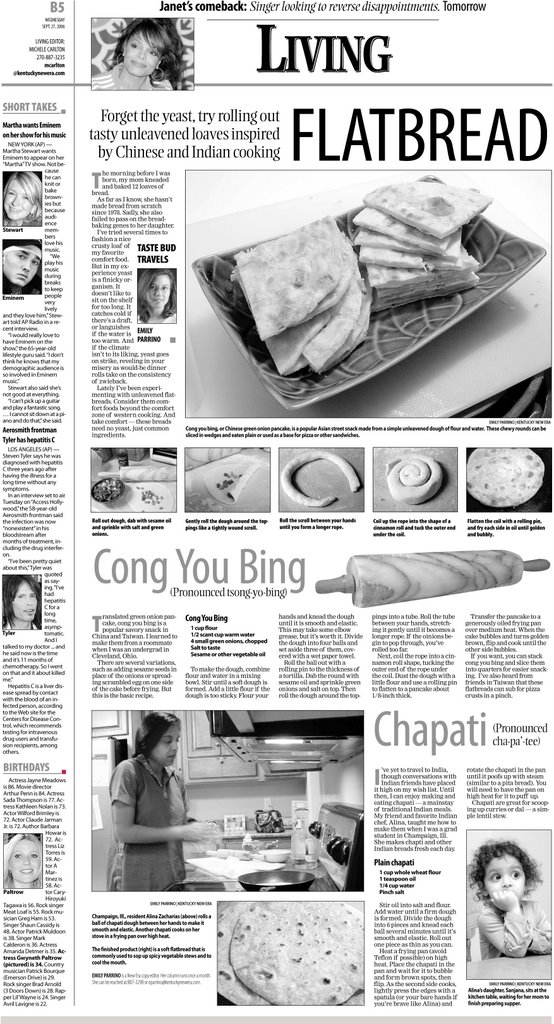
Flatbreads

Forget the yeast, try an unleavened loafTaste Bud Travels
Emily Parrino
(My food column for Wednesday, Sept. 27)
The morning before I was born, my mom kneaded and baked 12 loaves of bread.
As far as I know, she hasn’t made bread from scratch since 1978. Sadly, she also failed to pass on the bread-baking genes to her daughter.
I’ve tried several times to fashion a nice crusty loaf of my favorite comfort food. But in my experience yeast is a finicky organism. It doesn’t like to sit on the shelf for too long. It catches cold if there’s a draft, or languishes if the water is too warm. And if the climate isn’t to its liking, yeast goes on strike, reveling in your misery as would-be dinner rolls take on the consistency of zwieback.
Lately I’ve been experimenting with unleavened flatbreads. Consider them comfort foods beyond the comfort zone of western cooking. And take comfort — these breads need no yeast, just common ingredients.
Cong You Bing (Pronounced tsong-yo-bing)
Translated green onion pancake, cong you bing is a popular savory snack in China and Taiwan. I learned to make them from a roommate when I was an undergrad in Cleveland, Ohio.
There are several variations, such as adding sesame seeds in place of the onions or spreading scrambled egg on one side of the cake before frying. But this is the basic recipe.
Cong You Bing
1 cup flour
1/2 scant cup warm water
4 small green onions, chopped
Salt to taste
Sesame or other vegetable oil
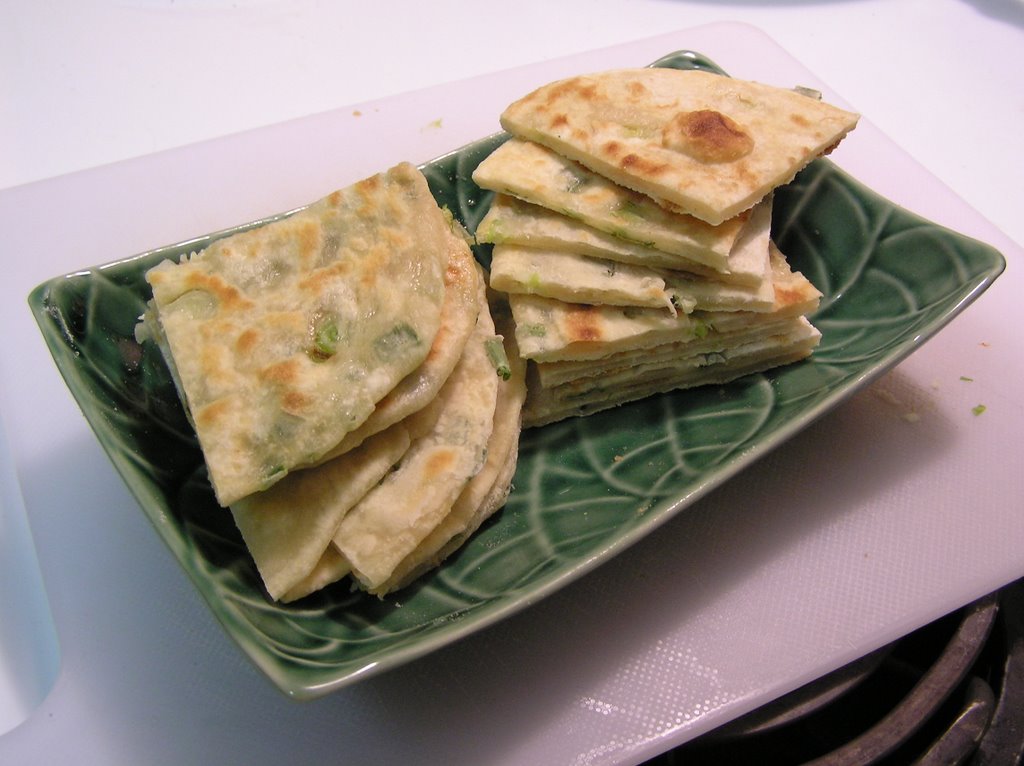
To make the dough, combine flour and water in a mixing bowl. Stir until a soft dough is formed. Add a little flour if the dough is too sticky. Flour your hands and knead the dough until it is smooth and elastic. This may take some elbow grease, but it’s worth it. Divide the dough into four balls and set aside three of them, covered with a wet paper towel.
Roll the ball out with a rolling pin to the thickness of a tortilla. Dab the round with sesame oil and sprinkle green onions and salt on top. Then roll the dough around the toppings into a tube. Roll the tube between your hands, stretching it gently until it becomes a longer rope. If the oinions begin to pop through, you’ve rolled too far.
Next, coil the rope into a cinnamon roll shape, tucking the outer end of the rope under the coil. Dust the dough with a little flour and use a rolling pin to flatten to a pancake about 1/8-inch thick.
Transfer the pancake to a generously oiled frying pan over medium heat. When the cake bubbles and turns golden brown, flip and cook until the other side bubbles.
If you want, you can stack cong you bing and slice them into quarters for easier snacking. I’ve also heard from friends in Taiwan that these flatbreads can sub for pizza crusts in a pinch.
Chapati (Pronounced cha-pa’-tee)
I’ve yet to travel to India, though conversations with Indian friends have placed it high on my wish list. Until then, I can enjoy making and eating chapati — a mainstay of traditional Indian meals. My friend and favorite Indian chef, Alina, taught me how to make them when I was a grad student in Champaign, Ill. She makes chapti and other Indian breads fresh each day.
Plain chapati
1 cup whole wheat flour
1 teaspoon oil
1/4 cup water
Pinch salt
Stir oil into salt and flour. Add water until a firm dough is formed. Divide the dough into 6 pieces and knead each ball several minutes until it’s smooth and elastic. Roll out one piece as thin as you can.
Heat a frying pan (avoid Teflon if possible) on high heat. Place the chapati in the pan and wait for it to bubble and form brown spots, then flip. As the second side cooks, lightly press the edges with a spatula (or your bare hands if you’re brave like Alina) and rotate the chapati in the pan until it poofs up with steam (similar to a pita bread). You will need to have the pan on high heat for it to puff up.
Chapati are great for scooping up curries or dal — a simple lentil stew.
Emily Parrino is a New Era copy editor. Her column runs once a month.
Thursday, August 17, 2006
Clip: Herbs on Ice

Here's an example of what I do all day...
Column, plant photos, illustration and page design by me. I know you can't really read it, but non-southerners might notice that my deck uses the terms "sweet and unsweet." In the South, the servers will ask you if you'd like sweet or unsweet tea. Sweet is reeeeally sweet. Unsweet is just normal iced tea. Anyway. The column is about herbal teas I enjoyed in Taiwan and my inspiration to make infusions out different herbs from my container garden.
Here's the text of the story:
Herbs on ice
Botanical blends take summer teas beyond sweet and unsweet
Wednesday, August 16, 2006 1:15 PM CDT
Emily Parrino TASTE BUD TRAVELS
“If it moves, they’ll eat it.”
So goes the joke about the Chinese and their thrill-seeking approach to food. I’d like to expand the proverb with “If it grows, they’ll drink it.” Where else but Asia can one find 7-Elevens on every street corner, stocked wall-to-wall with things like winter melon juice or peanut milk or rosebud tea?
When my husband and I lived in Taiwan, it was always fun to snag some of these liquid wonders as souvenirs for my husband’s dad, who got a kick out of drinking “something different.” He still talks about the asparagus juice.
Convenience stores weren’t the only places to find unusual thirst quenchers. While I lived in Taiwan, I grew accustomed to an afternoon “tea break” — an unofficial but regularly observed trip with my co-workers to the tiny tea stand around the corner from our office. The stand was about the size of a closet. Yet it was able to produce over 100 flavors of tea — some herbal, some fruity and some floral. Some came equipped with oversized straws to accommodate chewy tapioca balls or gummy gelatin or chunks of fruit. The tea could also be sweetened or plain, with milk or without, hot or icy. Whatever the concoction, it was only about 60 cents.
I bid my days of gulping fresh aloe tea goodbye when I moved back to the U.S. In the South, the most popular teas are “sweet” or unsweet.” But I see a world of potable possibilities growing around me.
My father-in-law is also an adventurous gardener. The small backyard patch he started about a decade ago has grown each year to make room for another variety of squash or cultivar of thyme. Spring through autumn, my mother-in-law is ever faithful to weave his wares into her home-cooked meals.
The first summer after we moved back to the U.S., she had prepared a pot of fresh peppermint tea from the abundance of the garden. Though mint has always been my herbal teabag of choice, I was stunned by the superior strength and smoothness of the fresh infusion.
This summer, I decided to grow a few of my own herbs to have on hand for that next beverage break craving. My “tea stand” is open for business, and always open to new flavor suggestions.
3 recipes for tea Time
Iced Vanilla Mint Tea
Though I think peppermint is perfect by itself, my father-in-law has discovered an even more indulgent partnership of flavors, adding creamy vanilla to the crisp tea. To make it, drop 1/4 cup fresh peppermint leaves into 2 quarts of boiling water.
Turn off heat and cover.
Let leaves steep for a few minutes or several, depending on desired strength of tea. Remove leaves and chill. Before serving, add 2 drops of vanilla extract to each cup.
Lavender Milk Tea
Lavender has been used in European cooking for centuries, but my first sip of this perfumy herb was in Taiwan. To try this fragrant treat, fill a tea ball with 1 teaspoon of dried lavender buds. Common or English lavender lavandula angustifolia has a better taste than lavandula stoechas, also called French or Spanish lavender.
Submerge the buds in 1 cup of boiling water. Stir in 3 tablespoons milk or soymilk, and add sugar to taste.
Lavender tea is a unique treat served hot or chilled.
Lemon Thyme Tea
My mother-in-law and I knew thyme spiced up mild fish fillets, but we were curious whether it could make a good tea. The result was intense and tangy. Coil one sprig of fresh lemon thyme into a tea ball and let it steep in a cup of boiling water for 10 minutes. Add a teaspoon of honey, if desired.
According to herbalists, this invigorating infusion can help clear respiratory congestion and soothe indigestion. It also makes a nice afternoon pick-me-up.
Emily Parrino is a New Era copy editor. She can be reached at 887-3298 or eparrino@kentuckynewera.com. Her column runs once a month.
Tuesday, July 25, 2006
Some pages
Tuesday, June 27, 2006
Pizza Planet

(Kentucky New Era food column for June 28)
I arrived in Taipei as a newlywed and new to the kitchen. Sadly, my training in Chinese cooking never progressed very far because I was too busy sampling local fare to prepare it myself.

My husband Joe and I prided ourselves on trying new and usual things. Like durian—a pale yellow fruit that tastes like custard and smells like dung. Or the less-than-sanitary night markets where we discovered squid stew, oyster omelets and tofu in every form imaginable. We ate and enjoyed it all.
Almost.
Ironically, the foods I couldn’t stomach were the Taiwanese versions of American classics. The first time I saw a pizza crust smothered in an alien array of toppings — like seafood, peas, corn, carrots and diced ham, drizzled with mayonnaise — I was appalled. I was disoriented. I was a long way from home.To fill that small but intense culinary void, I needed to cook my own home-style foods. One time, my co-workers invited us over to make personal pizzas in their toaster oven. They provided pre-made crusts, cheese and warm chocolate chip cookies from Subway (which, incidentally, did not suffer any cultural translation). Joe and I splurged on imported sauce, canned olives, artichokes, capers and other un-Asian veggies. Ten minutes of preparation and presto: we were transported back to American junk-food heaven.
I never acquired a taste for Taiwan specialties like "Seafood Jungle Pizza," but seeing the country’s distinct cultural twist on a non-native dish made me wonder how much American-style pizza has strayed from its Italian ancestor.
The first Neapolitan pizza is said to have had only four toppings — real mozzarella (made from water buffalo milk), sliced tomatoes, fresh basil and oil. Today Italy accepts this and two slight variants as authentic pizza.
Fifteen minutes of Internet research taught me Taiwan is not the only country to violate Napoli’s rules for pizza toppings. In fact, pizza might be the most globally adopted and adapted dish around. In England, tuna and sweet corn adorn one of Domino’s specialty pizzas. Greece adds its national personality to a pepperoni pizza with olives, feta and oregano. In Mexico, pizza with frijoles and chorizo is common. In India, they get topped with lamb and pickled ginger.
But it gets weirder. Many countries seem to use pizza as a base for other ethnic flavors. A recent visit to Taiwan’s Pizza Hut site revealed Korean Kim Chi (aged, spicy pickled cabbage) pizza and German sausage-crust pizza. According to Domino’s Web site, the Netherlands like "Shwarma" flavored pizza. Shwarma is not Dutch invention, but rather Middle Eastern marinated lamb. In Switzerland, people have embraced Tex-Mex pizza spiked with jalepeno peppers.
Though I’ve been back in the states for two years, and what I once believed to be "normal" pizza is readily available, I still prefer to make my own. Lately I’ve been making use of summer’s bounty. I see plenteous topping possibilities—for sale at local farm stands, ripening in backyard vegetable patches and sprouting in my patio herb garden. So don’t be shy ... add the ingredients from your favorite meal to a pizza, or pick toppings that reflect your ethnic background. Or if you’re up for a real challenge, try to create something that’s never been done before. Good luck.